How do I learn a Language?
- Aricka M
- Aug 10, 2022
- 4 min read

Learn Any Language:
Where to start
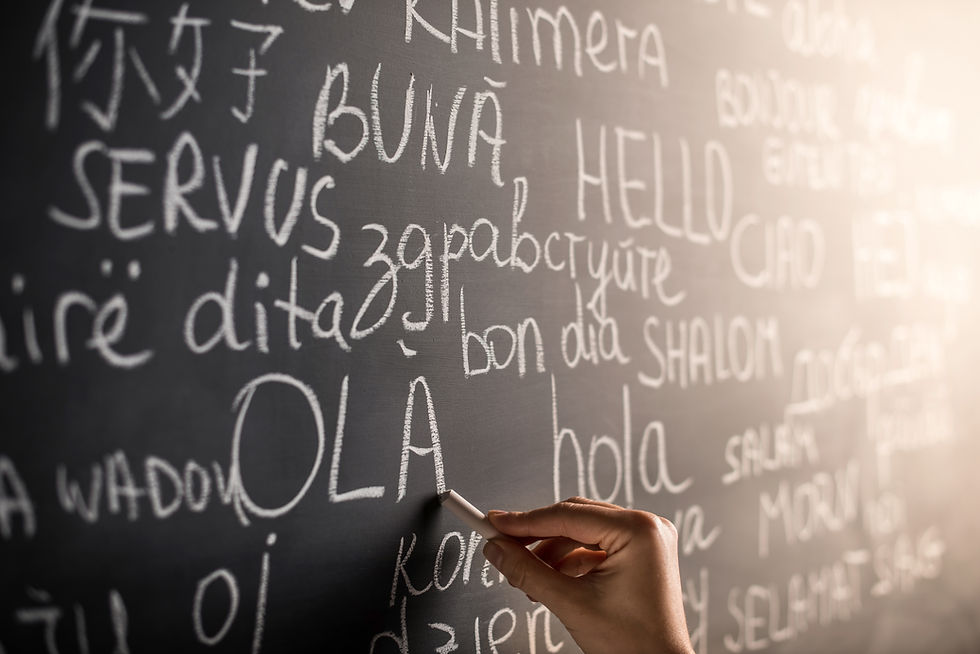
Maybe some other Spanish teachers have experienced this, or maybe it’s just me, but my students had a tendency to tell me that what I was teaching them only made sense because I am fluent. While I didn’t necessarily think they were correct, I had to admit that it had been quite a while since I had tried to learn a language from scratch. So, as any new teacher with too much energy, I set off to learn German, Italian, Portuguese and French (although quite briefly). Through this experiment, I found what I consider to be the best way to teach a language for understanding (not memorization). There are many teachers who prefer to teach phrases and that is fine, but I believe a solid base in the language means that you don’t need to be set up for a certain conversation- you can create your own conversation or apply the knowledge you know to any conversation.
Alphabet
I like to start here because… well, it’s a very good place to start. The alphabet sets up the sounds that students will hear and say on a daily basis. This will help them get a grasp on spelling (in Spanish anyway) and the sounds that the letters make. There are many activities that can be done with the alphabet to encourage them to begin hearing and saying the letters correctly. This will also get them in the habit of correctly pronouncing words that will come up often.
Cognates
Cognates are a great way for students to see early and quickly that many words are cognates (the same in both languages). There are many stories that are made up of mostly cognates- I like to post one or hand it to the students and ask them to figure out what the story is saying. I do this before they have learned any other words so that they can see just how easily you can figure out a paragraph or story with what you already know.
Circumlocution
I like to get this one in early (usually I start talking about it on syllabus day). We will work on it a lot throughout the year, but along with each of these sections, I do have students start memorizing vocabulary words, and I want them to start recognizing early that they do not need to know every word to be able to speak well. If you want to learn more about circumlocution, click here.
Person
Understanding the concept of “person” is imperative to understanding how to conjugate and thus create sentences, so I like this to be my next stop. Use TPR to help students understand better how the thought process of “person” works. Practice both with the conjugation boxes and without them. If you would like a run-down on what I mean by “person”, click here.
Verbs and Conjugation
After understanding the concept of person, we should start using them for something, so I like to introduce verbs next. I start with a basic “what kind of verbs there are” and move onto conjugation from there. It is important to connect them with the pronouns/ nouns discussed in “person” so that students can make the connection and hopefully be able to apply it to the rest of the tenses and verbs learned throughout their time in Spanish. I also, like all processes, scaffold this process and teach it in steps so that in the future, if I ask a student to conjugate and they think they don’t know how, you can take it back to step one and so on. This has never not worked for me. When taken back to steps, all students are able to walk through how to conjugate a verb (and build a sentence). To see how I teach conjugation, click here. Note that I start here with just regular verbs. I continue on with irregulars, but, because there is no pattern, I like to give them their own section(s) and treat them as individual vocabulary.
Build a sentence
Throughout the last two sections, I will have students make notecards that allow them to connect the verbs endings and people. Once they have these pieces of the puzzle, I like to show them how easy it is to create sentences. We will continue to add to our puzzle pieces throughout Spanish class when we learn about adjectives, indirect and direct objects, adverbs and so on. Students are able to take the different pieces and build sentences with their hands (much more fun than writing) using different vocabulary words from class.
Reading
I continually read to my students from day one. Even when they are panicking that they don't know any Spanish, they see quickly that through the use of pictures and cognates, they are able to understand a message. This also allows them to constantly see what they are learning in class in action, hear the language, find patterns, and offers many repeat after me opportunities. Use different children's stories that they know or ones that they don't know.
Those are the very basics to learning a language. If you would like to see how I create my language learning notebooks, stay tuned!
As always, if you have any additional ideas or questions, leave them below!


Comments